What game is Turkey playing?

Research
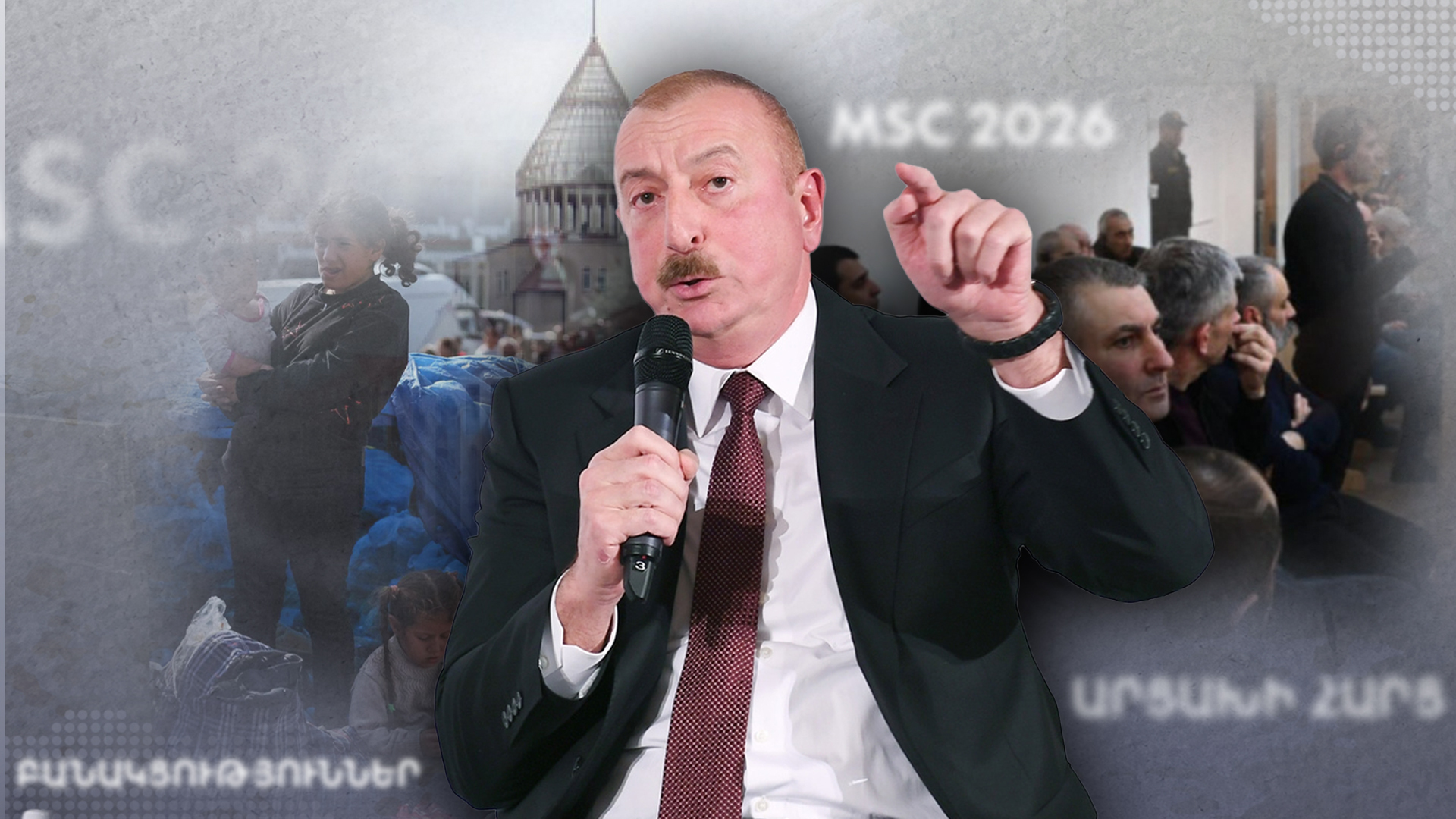
From Feb. 13–15, the 62nd annual Munich Security Conference took place. Unlike the Armenian authorities, the president of Azerbaijan participated in the conference. Ilham Aliyev’s statements in Munich should be understood not only in the context of his country’s political rhetoric but also within its broader geopolitical strategy.
The Azerbaijani president, speaking before an international security audience, claimed that a process of interstate relations and peacebuilding with Armenia has begun. He attempted to present a “new situation” that has emerged and will continue to emerge, implying that the situation created through the use of force must be accepted as an irreversible fact.
“A completely new situation has arisen. We expect Armenia to fulfill its obligations for signing a peace treaty,” Aliyev declared, stating that “there is peace at the border” and that a “new situation” has been established.
This statement indicates that the balance of power has shifted after the war, and it must be recognized. In international relations, a “new situation” is not a legal category but a condition legitimizing the consequences of aggression through military power, which will serve as the foundation for peace negotiations.
In reality, this is an imitation of a peacebuilding process, as it codifies the aggressive party’s imposed political and capitulationist strategy, exerting clear pressure on Armenia—a pressure to which Yerevan has offered no response.
Let us highlight the main points of the Azerbaijani president’s message:
Thus, the ideas expressed in Munich were clear: Azerbaijan views the “peace treaty” as a unilaterally imposed act. Aliyev declared that “the conflict is over” and that a peace treaty must now be signed, but he presented the following preconditions for its conclusion:
Aliyev also sought to close the issue of Artsakh, stating that “Nagorno-Karabakh no longer exists as a political entity.” He presented the matter as an internal Azerbaijani matter and rejected any international intervention.
The logic of coercion is clear: achieve Armenia’s de facto and complete capitulation under the guise of “peace.” In such circumstances, when one of the conflicting parties operates under a zero-sum logic—where the winner takes all and the other side gets nothing—the establishment of peace becomes unstable, manipulative, and deprived of guarantees and international safeguards. Such documents can only serve as a basis for re-escalation of war.
Armenia’s current authorities’ negotiating behavior, their responses to continuous Azerbaijani pressure, positional justifications, and failure to respond to Baku’s attempts to revise history all lend legitimacy to revisionism and the legalization of crimes against humanity. By distorting history, Aliyev seeks to retain leverage over Armenia, exploiting the longevity of its current leadership and the possibility of its reelection in June this year.
Baku also considers changes to Armenia’s Constitution as a prerequisite for a peace treaty, stating that “Armenia must make changes to its Constitution in order to sign a peace agreement with Azerbaijan.” First, Aliyev expressed hope that “the peace agreement will be signed this year,” then added, “the peace agreement will be signed the day after the change in Armenia’s Constitution.” In effect, the peace treaty is coupled with a precondition, making the negotiation an asymmetric process. According to Aliyev, “There is an understanding between Armenia and Azerbaijan regarding constitutional changes to Armenia’s Constitution. And that understanding concerns what must be done and in what order.” Considering Azerbaijani president’s statement—which Armenia’s leadership has not refuted—it appears that the Armenian authorities have misled the public throughout the post-war period, claiming that constitutional changes are not being made at Azerbaijan’s request and that Azerbaijan has no influence, while in fact even the sequence of these changes has been coordinated with Baku.
The “corridor” issue was also addressed at the summit. Aliyev framed the matter in the context of Eurasian security, stating that “the corridor will run along Azerbaijan-Armenia-Azerbaijan [meaning Nakhijevan]-Turkey and then to Europe.” In other words, Aliyev rules out the route from Nakhijevan entering Yeraskh, reaching Gyumri, and then Kars. Interestingly, the Armenian authorities try to shift the blame for its diplomatic failure onto Russia, claiming that the railway will not pass through Yeraskh because the Armenian railway is managed by Russians, which poses a problem for some countries. This is nothing more than a propaganda tactic aimed at deflecting responsibility for yet another diplomatic-political failure regarding the TRIPP route. Notably, Aliyev does not make such statements in Munich nor consider the Nakhijevan-Yeraskh-Kars option, regardless of who controls the railway.
At Munich, Aliyev also addressed the issue of Armenian prisoners of war. He compared their trial in Baku to the Nuremberg trials and described Armenian POWs as “criminals more dangerous than Nazis.” With this, official Baku assigns Armenia the status of capitulated Germany and seeks to justify its own illegal conduct before the international community under the pretext of “denazification” and “counter-terrorism” operations.
Aliyev, aiming to highlight his country’s regional role, emphasized a number of energy and transport projects, particularly the Baku-Tbilisi-Kars railway. He also noted that Azerbaijan could become a “regional transport hub,” connecting Europe and Asia strategically.
In Munich, Azerbaijan once again demonstrated that displays of power are among the key instruments of its foreign policy success. In this situation, does Armenia have sufficient resources and resilience to counter threats and risks endangering its sovereignty? Aliyev’s Munich speech was not about reconciliation but about consolidating dominance through stabilization. His strategy is clear: accelerate the signing of a peace treaty while maintaining leverage over Armenia, present himself as a predictable partner to the international community, show that regional stability depends on Baku, replace the “warring state” image with a peace-seeking one and portray Armenia as obstructing the peace process to legitimize potential re-escalation.
Under conditions of a non-initiating foreign policy and absent diplomatic agenda, Armenia has been sidelined from positions that allow agenda-setting or proposal-making. In Munich, we witnessed Azerbaijan’s attempt to legalize post-war realities and territorial annexations, tie the peace issue to its illegal and illogical demands, and convince the international audience that the process is “constructive.” This is a classic example of “softly worded hard politics,” and by failing to respond, Armenia not only weakens its diplomatic positions at the negotiating table but also uses this “trump card” to secure international acquiescence to ongoing and anticipated repression in electoral Armenia.