


Not having political prisoners in Armenia is a matter of national security
26.11
2025
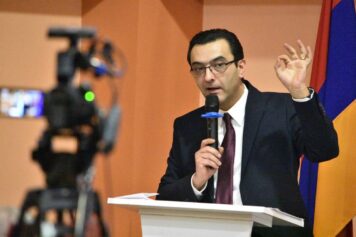
The issue under discussion—by its very title, content, intended audience, and implications—is inherently uncomfortable for the current authorities. It is therefore unsurprising that the ruling regime will seek to reframe the topic for both domestic and external audiences, shifting it into a space of manipulation, where it can operate freely and without constraints. When it comes to interpreting this issue, the playing field is far from level: on one side are the outraged segments of society, including both parliamentary and extra-parliamentary opposition forces; on the other side are the authorities, their satellite groups, and the vast propaganda apparatus at their disposal. This is why I attach particular importance to discussions and hearings of this kind. I firmly believe that our public has the right to hear well-grounded arguments from the state institution maintained by their own taxes—the National Assembly—despite the obstacles created by the authorities.
The absence of political prisoners in Armenia is a matter of national security—politically, morally, and in terms of fundamental values. Freedom of thought and expression in Armenia must never be reduced to a “homework assignment” designed to convince foreign organizations or geopolitical patrons that the country is a democratic state—or that it is democratic only “upon request” and when convenient.
Ensuring political pluralism is a cornerstone of statehood and one of the most significant achievements in the history of the Armenian people and Armenian statehood—an achievement that is now entirely absent. Moreover, Armenia today has set alarming records in the number of individuals persecuted and prosecuted for their political beliefs.
To those who quail at the very term “political prisoner,” let me remind you: the issue in question does not concern a single group, party, or political period. We are addressing what international organizations refer to as “restricted civil liberties” and “politically motivated prosecutions.” My remarks rest not only on well-substantiated political arguments but also on clear standards of international law and documented facts within the Republic of Armenia. Thus:
I. Standards of International Law
1. UN International Covenant on Civil and Political Rights (ICCPR)
Armenia is obligated to ensure:
Freedom of assembly (Article 21),
Freedom of expression (Article 19),
The right to political participation (Article 25),
Protection from arbitrary arrest or detention (Article 9).
The Convention also prohibits persecution based on political opinion.
The detention of an individual for criticizing the government or for organizing or taking part in a protest constitutes a clear violation of international law
2. OSCE Copenhagen Document (1990)
The OSCE stipulates that participating states are obligated to:
Guarantee the free exercise of peaceful assembly,
Refrain from criminal prosecution for opposition activities,
Exclude selective justice.
3. European Convention on Human Rights
Right to liberty and security (Article 5),
Freedom of expression (Article 10),
Freedom of assembly and association (Article 11),
Prohibition of restrictions imposed for political purposes (Article 18).
The European Court has repeatedly ruled that when a state employs legal mechanisms to suppress political opponents, it violates Article 18. Like several dozen other countries, Armenia is obligated to honor its commitments.
“In just the past few years, opposition figures have faced disproportionate detention, unjustified extensions of pretrial investigations, artificial delays in cases, and the ‘revival’ of criminal proceedings during periods of heightened political activity. What is this, if not selective justice?”
The use of restrictions for political purposes is the gravest accusation a state can face. If such practices persist, the state risks losing international credibility, undermining democratic institutions, escalating internal tensions, and deepening societal divisions. Coupled with campaigns targeting the Armenian Apostolic Church, these actions disrupt the core components of national identity, ultimately weakening the very foundations of our existential systems.
The current authorities, surviving on fragile and precarious legitimacy, are expanding the wave of political repression day by day, restricting opposition activity and suppressing public criticism in an effort to fully control the political field. This is the modus operandi and ideology of a dictatorship, no matter how much they claim to have no ideological “isms.” Their approach is totalitarianism—or, in its milder form, authoritarianism—which will inevitably lead to the marginalization of our state and the irreversible weakening of its positions.
It is unrealistic to expect rational or de-escalatory steps from the ruling regime or from the judiciary subordinated to it. Yet through public, political, and civic pressure, it may still be possible to secure certain outcomes—for example, demanding the creation of an independent parliamentary commission to review all politically motivated cases and restore the rights of political prisoners. The authorities’ reaction is predictable, but we cannot accept a reality in which, in Armenia’s prisons, secular and clerical prisoners of conscience are prosecuted under the same charges as our compatriots who are illegally and falsely tried in Baku.
The issue of political prisoners is not a matter for the opposition or the government; it is a question of the moral character and political maturity of society, of whether we have a future at all. It is the value-based litmus test of the state. The authorities have turned the law into an instrument of pressure, and this is already a political crisis—not a legal process. Restoring the rights of political prisoners is not merely an issue concerning individuals; it reflects a crisis in the state, the justice system, and the legitimacy of public authority. The restoration of these rights—regardless of one’s political views—becomes a fundamental condition for restoring the state’s credibility and sovereignty.
The credibility of a state is measured by the quality of its justice. A government that tells tales about being “pro-state” should remember that a state is valued only to the extent that it protects the rights of even its opponents. Political persecution is characteristic of a weak, intolerant, illegitimate, and ineffective government. Our country is one of the few in the region that possesses a continuity of Christian, moral, and legal traditions, is founded on universal civilizational values, and has committed itself to upholding democratic institutions.
The existence of political prisoners undermines this civilizational model because it:
Completely delegitimizes the regime caught in false pretenses of sovereignty,
Gives adversaries grounds to point to Armenia’s inconsistency with its proclaimed values,
Weakens Armenia’s positioning in foreign policy as a democratic, values-driven state.
Armenia’s civilizational mission cannot coexist with the legacy of political persecution—at least not under the current authorities. This is not only a violation of justice but also a threat to independence. It is something we must not tolerate—neither as a society nor as a state.