What game is Turkey playing?

Research
Part Two
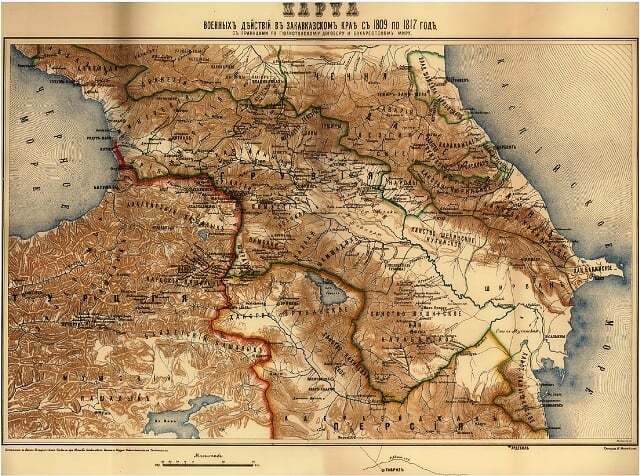
The Treaty of Gulistan and its significance: The Treaty of Gulistan was signed in the village of Gulistan in Karabakh. During this war, Armenians provided significant assistance to the Russian army. After the Russo-Persian and Russo-Turkish wars, Russia became the main military power in the Caucasus.
At the same time, the Russo-Turkish War was ongoing (1806–1812). Russian troops achieved major victories against the Ottoman Empire on both the Caucasian and Danubian fronts. At the end of 1811 (October–December), under the command of General-Field Marshal M. Kutuzov, the Russian army completely crushed the Turkish Danubian army, forcing Turkey to seek peace. Russia was interested not only in making peace with Turkey but also with Persia, as Franco-Russian relations had severely deteriorated, and an invasion of Russia by Napoleon’s army was expected.
While negotiations with Turkey ended successfully and a peace treaty was signed in Bucharest on May 16, 1812, the Russo-Persian peace negotiations proceeded differently. Under pressure from the British leadership, Persia avoided signing a peace treaty with Russia. Britain continued to provide multifaceted support to keep Persia engaged in war against Russia. In February 1812, General Nikolai Rtishchev replaced General Tormasov as commander of the Caucasian troops and, in spring, received instructions from the court to restart negotiations with Persia regarding a peace agreement. Russia’s proposal was once again rejected. Moreover, some time later, taking advantage of Napoleon’s invasion of Russia and the difficult situation for the Russians, the Persians resumed their military operations.
However, this new military initiative also failed, and in an even more humiliating manner. On Oct. 18–19, 1812, General Pyotr Kotlyarevsky’s detachment suddenly attacked the Aslanduz fortress, where Abbas Mirza’s main forces had been stationed. The opposing forces were crushed and fled in panic. This victory was followed by another of Kotlyarevsky’s victories near Lenkoran on Oct. 31, 1812. The defeat of the Persian forces at Aslanduz and Lenkoran finally dispelled any illusions of victory. In effect, the heavy blows suffered by Persia from Russia in 1812, combined with the defeat of Napoleon’s army in Russia, compelled Persia to propose peace.
The treaty was signed in Karabakh, at the Gulistan fortress, on Oct. 12, 1813, between the Russian Empire and Qajar Persia, marking the end of the first Russo-Persian War (1804–1813). On the Russian side, it was signed by the Viceroy of the Caucasus, N. Rtishchev, and on the Persian side by the Foreign Minister, Mirza Abdul Hassan Khan. Article 3 of the Treaty of Gulistan recognized all of Russia’s territorial gains in the South Caucasus. The treaty formalized the annexation of Eastern Georgia (the former Kingdom of Kartli-Kakheti) to Russia, which had already been incorporated in 1801. New territories also passed to Russia, including Dagestan, Georgia, Mingrelia, Imereti, Guria, Abkhazia, Karabakh (which had been annexed during the war on May 14, 1805, under the Treaty of Kurakchay between Ibrahim Khan of Karabakh and Tsitsianov). Additionally, the treaty confirmed the inclusion of territories such as Lowland Karabakh, including Jrakan (Jabrayil), etc., Ganja (Elizavetpol), Shaki, Shirvan, Derbent, Baku, and Talysh khanates, as well as the Lori, Zangezur, and Shoragyal (Shirak) regions.
The treaty not only cemented Russia’s territorial acquisitions in the Caucasus but also limited Britain’s aim to achieve absolute dominance in the Middle East. Russia gained exclusive rights to maintain a naval fleet in the Caspian Sea, and both countries were granted the right to free trade. The unification of much of the Caucasus under Russia had progressive significance for the region’s inhabitants, especially Christian peoples, as they were freed from Ottoman invasions.
The Treaty of Gulistan laid the foundation for relations between Russia and the peoples of the Caucasus. The Armenian people, who had long been caught in the midst of Russo-Persian conflicts, began to place great hopes in Christian Russia. It should also be noted that the treaty was the first legal document formally recognizing Russia’s rights in the Caucasus. The Treaty of Gulistan had a unique impact on the political development of the Caucasus, sharply altering the political map of the South Caucasus and strengthening Russian supremacy over much of the region. For Russia, the treaty was of great importance in terms of ensuring state security—a strategic understanding that, in our view, Russia today has partially abandoned, favoring tactical considerations over strategic ones. Subsequent military-political developments unfolded so that the Treaty of Gulistan maintained long-term peace, and only thirteen years later did the second Russo-Persian War become inevitable.
The Treaty of Gulistan remains relevant today, as its results and consequences continue to influence the region’s political events. These include:
The Treaty of Gulistan is not merely a historical document; it forms part of the foundation of contemporary international relations regarding borders. Its study warns us that regional and political security must be built on one’s own strength and the careful choice of allies, not solely on external agreements.