
What game is Turkey playing?
Research

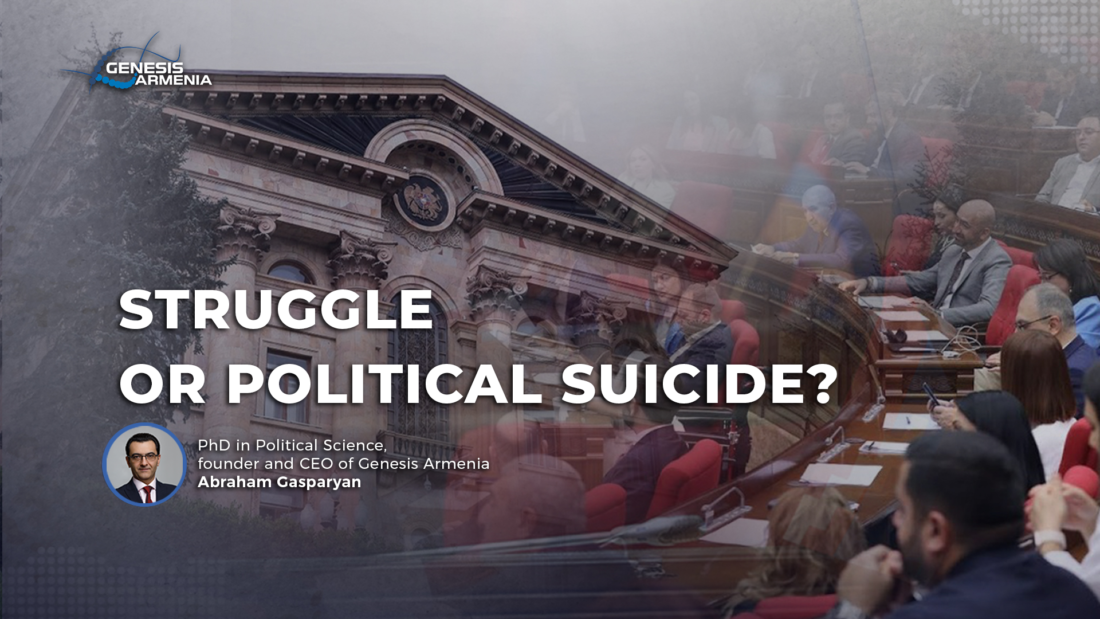
The opposition’s complex dilemma over whether to tell the world there is no democracy in Armenia, or to impose a national agenda through all political levers.
The opposition’s boycott of parliamentary work or a mass resignation from mandates does not lead to a weakening of the ruling power; on the contrary, it strengthens the institutional position of the governing force. Opposition actors usually resort to such a step when they are convinced that the electoral process has not reflected the public will, or when they seek to create a legitimacy crisis. In practice, however, such tactics have rarely led to government resignation or the calling of new elections—with one exception: a total, systematic, disciplined, multi-layered, targeted blitz uprising involving interest groups, pressure groups, the state bureaucracy, and broad popular masses.
The seats of forces that have renounced their parliamentary mandates are not automatically or legally transferred to other parties that failed to pass the electoral threshold. The rule requiring representation of “three political forces” in parliament applies at the stage of initial seat allocation, not in cases of post-election resignations. Let us consider two scenarios:
The Strong Armenia, the Armenia Alliance, and the Prosperous Armenia Party— referred to here as the collective opposition—completely resign their parliamentary mandates (a complex issue requiring strict internal discipline and vertically coordinated decision-making), leaving only the Civil Contract party in the National Assembly with its 61 seats.
If the “collective opposition” takes their seats and the National Assembly begins its work, and then from the very first session the opposition resigns all mandates, the parliament would be left without an opposition.
If the three opposition forces resign not only the mandates of elected MPs but the entire party lists, a serious constitutional-legal problem arises. Why? According to the Constitution of Armenia, the National Assembly must ensure not only the existence of a majority but also the institutional presence of an opposition. Armenian legislation states that the formation of the National Assembly is not dependent on the mandatory or factual presence of an opposition; the Constitution does not foresee such a collective boycott situation, nor does it provide a concrete solution for it.
The worst-case scenario is when the opposition takes its mandates, parliament begins its work, and only then do they resign. In that case, the National Assembly is already formed, its first session has been held, MPs have received their mandates, and parliament has begun exercising its powers. If they then resign, they are replaced by the next candidates on the same electoral lists. If all subsequent candidates also refuse, and the lists are fully exhausted, the seats remain vacant. The result is effectively: 61 Civil Contract MPs and 44 vacant seats, meaning the National Assembly is formed and the governing power faces no institutional obstacle.
What are the political consequences of all this?
If Civil Contract holds 61 seats and the remaining 44 mandates remain vacant:
International experience and possible opposition actions
If in a newly elected parliament Civil Contract holds 61 seats while all opposition mandates remain vacant, then legally the parliament can continue to function, but politically a serious crisis of representation and legitimacy will emerge. Such situations are rare internationally, but global experience shows that mass opposition boycotts are usually more a tool of political pressure than an effective mechanism for regime change or systemic transformation.
For example, in Bangladesh, the main opposition force—the Bangladesh Nationalist Party (BNP)—and several other opposition parties boycotted the 2024 parliamentary elections, arguing that free, fair, and transparent elections were impossible under the current government. The opposition’s calculation was to demonstrate that the resulting parliament lacked real political representation and to question its legitimacy. However, the outcome was the opposite: the ruling Awami League retained power and continued to control parliament. The state governance system continued to function, lawmaking was not disrupted, and the opposition lost its parliamentary platform, committee representation, and daily oversight capacity. While talk of a political crisis persisted, institutionally the government became even more centralized.
In 2005, Venezuela’s main opposition forces boycotted parliamentary elections, arguing that electoral conditions were unequal. Their aim was to challenge the legitimacy of the results internationally and show that parliament did not reflect political pluralism. However, the consequences were severe for the opposition itself: pro-government forces gained near-total control of parliament and were able to pass legislative and constitutional changes without serious checks. Later, many Venezuelan opposition leaders admitted that the boycott was a strategic mistake, as it effectively handed the ruling power the only institutional platform in which it could have been challenged. After that experience, the opposition largely returned to electoral and parliamentary struggle.
In 2020, ahead of parliamentary elections in Serbia, a significant part of the opposition announced a boycott, claiming that political competition was heavily unequal and the media landscape disproportionately controlled by the government. The logic was that non-participation would create a legitimacy crisis and increase international pressure. After the elections, however, parliament was formed and operated without a strong opposition presence. The ruling camp gained near-unlimited control over the legislature. Although international organizations noted issues with political competition, the government’s functionality was not affected. Within the opposition, it later became widely accepted that leaving parliament reduced their political weight and allowed the government to operate more freely.
In the post-Soviet space, the most instructive case is Georgia. Here, the opposition did not boycott elections but, after running, refused to fully exercise their mandates. After the 2020 parliamentary elections, major opposition forces claimed the results were falsified and refused to take part in normal parliamentary work. Nevertheless, parliament was formed and began functioning with a majority from the ruling Georgian Dream party. A few months later, the opposition faced a key problem: street protests did not lead to a change of power, while they were losing influence over the political agenda. Following European mediation and domestic negotiations, a significant part of the opposition returned to parliament. The conclusion was that even under disputed election results, abandoning the parliamentary platform entirely benefits the ruling power more than the opposition.
In 2019, Albania’s main opposition parties—the Democratic Party of Albania and its allies—not only boycotted parliament but also saw around 60 MPs collectively resign their mandates, demanding the resignation of Prime Minister Edi Rama and snap elections. The expectation was to create a constitutional and political crisis that would force negotiations on new elections. However, parliament was not dissolved. Successor candidates from electoral lists took the seats, a new parliamentary makeup was formed, and the government continued its work. As a result, the opposition remained without parliamentary leverage for several years before eventually returning to electoral competition. This is an important example because it involved not just a boycott but a mass surrender of mandates.
In Kosovo between 2014 and 2016, opposition forces repeatedly boycotted parliament for extended periods, and individual party leaders even resigned their mandates, claiming parliament had become an institution that merely legitimized government decisions. However, even in those conditions, the state governance system continued to function. The opposition was able to create political pressure, but not at a level that would lead to government removal or automatic dissolution of parliament. Instead, crises were resolved through negotiations, coalition reshuffles, or news elections.
In essence, international practice shows that mass resignation from parliamentary mandates usually leads to three main consequences:
Therefore, in the described scenario where Civil Contract holds 61 seats and the remaining 44 mandates are vacant, a legal governance crisis does not necessarily arise. However, the political system enters a condition that international practice typically describes as a weakening of competitive democracy and a crisis of the opposition’s institutional representation. For this reason, in many countries opposition forces, even when disputing election results, eventually return to parliament, considering that internal institutional struggle is often more effective than a full boycott.
P.S. The article does not discuss contested electoral legitimacy, illegal procedures, CEC complicity, mass electoral violations, unconstitutional interference by authorities, repression, arrests, or the generally anti-democratic nature of the elections.