What game is Turkey playing?

Research

The Need in “Narrative Equilibrium” and Its Strategic Value
In the pre-2020 period, the Azerbaijani government consistently sought to achieve what might be called a narrative equilibrium with Armenia. This effort was characterized by sustained attempts to construct or amplify stories of Azerbaijani victimhood, particularly through campaigns to document or, at times, fabricate alleged atrocity crimes committed by Armenians during the first Nagorno-Karabakh war. The strategic aim was to compel international organizations and foreign policymakers to adopt “both-sides-ist” approaches to the conflict, thereby neutralizing the moral asymmetry created by the well-documented anti-Armenian pogroms and forced displacements in Soviet Azerbaijan between 1988 and 1991.
Within this framework, irredentist narratives such as “Western Azerbaijan” and the claimed “right to return” for those who left Armenia during the late-Soviet and early post-Soviet periods served a dual purpose. Initially, they were designed to mirror and counterbalance Armenian claims of ethnic cleansing, effectively placing the two societies on ostensibly equal moral footing.
However, after the 44-day war of 2020, such irredentist claims were deliberately maintained and amplified to achieve further leverage and prevalence over Armenian side on two interconnected tracks. First, they were used to silence international criticism about Azerbaijan’s responsibility for unleashing the 2020 war, the nine-month blockade of the Lachin Corridor, and the forced displacement of approximately 110,000 Armenians from Nagorno-Karabakh in September 2023. Second, they began serving as an expansionist instrument, pushing Armenian government toward new concessions by reframing the so-called “right to return” not merely as a humanitarian or symbolic issue, but as a potential basis for Azerbaijani settlement within Armenia’s sovereign territory itself.
In this sense, the pursuit of “both-sides-ism,” and where possible, narrative superiority over Armenia, has remained a central pillar of Azerbaijan’s post-war information strategy. The “Western Azerbaijan Community” (WAC) embodies this approach, systematically mobilizing three major rhetorical clusters that reinforce the state’s propaganda line:
These rhetorical tools not only abuse, but also attempt to steal the structure and moral authority of human-rights discourse, appropriating its language of justice, rights, and return to legitimize expansionist objectives. By mimicking the vocabulary of victimhood and international law, the “Western Azerbaijan” narrative disguises political irredentism as a humanitarian cause. In doing so, it seeks to erase the moral distinction between aggressor and aggrieved, turning historical memory itself into a contested arena of influence and equivalence. As Saparov (2024) observes, “the combined effect of these techniques creates a reassuring impression that what is happening is an ordinary territorial dispute between two states”. In reality, what we observe is a deliberate re-engineering of history and perception, an effort to normalize expansionist claims under the veneer of restored justice.
Utilizing a systematic data analysis approach, this study analyzes narratives surrounding “Western Azerbaijan” and the claimed “right to return” in the discourse of “Western Azerbaijan Community” (WAC) and the Azerbaijani government. It aims to track the frequency of irredentist statements issued over time, identify patterns and dominant themes in the narratives promoted by these actors, and assess the extent to which they shape Azerbaijan’s irredentist agenda.
The Establishment and Objectives of the “Western Azerbaijan Community”
A state-backed non-governmental organization in Azerbaijan known as “Western Azerbaijan Community” (WAC), officially launched in August 2022 (the organization claims it is the successor of the “Azerbaijan Refugee Society” Association founded in 1989), has increasingly attracted public attention and intense media coverage both in Azerbaijan and abroad in recent years. The organization positions itself as an institution advocating for the interests and rights of the so-called “Western Azerbaijanis”, especially promoting the “Concept of Return”, which the organization defines as “the return of Azerbaijanis expelled from the territory of nowadays Armenia to their homeland and ensuring their individual and collective rights after the return as its primary goal” (WAC, 2025).
In the meantime, it has received consistent support from the Azerbaijani government since its inception. On December 24, 2022, in his second meeting with the representatives of the WAC, Azerbaijani President Aliyev stated “Western Azerbaijan is our historical land…and the Western Azerbaijanis will return to their native lands” (WAC, 2022). On 23 November 2024, Milli Majlis released a statement severely criticizing the Armenian Prime Minister Nikol Pashinyan for disregarding the WAC’s appeals to start a dialogue on the “issue of return of the people of Western Azerbaijan” (The Milli Majlis of the Republic of Azerbaijan, 2024). This stance has become even more resolute in the following years. On 20 December 2025, Adalat Valiyev, Head of the Department for Relations with Political Parties and Legislative Authority, took part in the subsequent general meeting of WAC and restated that the topic of “Western Azerbaijan” is a “priority state policy” of the Azerbaijani government (Media.AZ, 2025).
However, what broader themes lie behind the organization’s messaging and how its activity relates to the official line are the questions this analysis aims to unpack.
Methodology and Timeframe
A systematic data analysis approach was employed in this paper to disclose the organization’s messaging and the intensity of its activity. It analyzes all WAC’s statements published by the Azeri Press Agency (APA), a government-funded major media outlet in Azerbaijan, covering the timeframe from 9 January 2023 to 21 December 2025. The starting date was selected as it marks the first publication in the “Western Azerbaijan” section of the APA’s website, while the end date corresponds to the completion of data collection. Since publications of the news agency are available both in Azerbaijani and English, the data (titles, publication dates, full texts and links of each publication) were scraped in English. It amounted to 296 publications. This includes WAC official statements, interviews, speeches at public events such as conferences or seminars, letters addressed to international organizations, and social media posts as well as statements made by its proponents from the state apparatus.
The scraped statements were cleaned to remove stop words (pronouns, prepositions, conjunctions, etc.), duplicates, and non-informative entries. A bigram analysis, a quantitative text analysis technique to identify the most frequent pairs of consecutive words (expressions) in text data, was then performed to reveal the overall tone and the dominant themes the WAC promotes. The resulting top 50 bigrams were identified and visualized in a word cloud. In addition, based on the dates of publications, the statements were counted by month and visualized in a line chart to disclose the periods when the organization was relatively more active.
The same approach and timeframe were used to scrape the official statements (titles, publication dates, full texts and links) republished by APA to ensure methodological consistency and comparability between the two datasets. Contrary to the WAC statements, the official statements required careful filtering to catch those referring to the “Western Azerbaijan” and “return” context. Therefore, a set of keywords suggestive of irredentist sentiment, most of which based on the most frequent irredentist expressions identified in the WAC’s statements in advance, were predefined to filter the dataset. The list includes the following keywords/expressions: “Western Azerbaijan”, “Zangezur”, “ancestral land(s)”, “ancestral homeland”, “historical land(s)”, “historical homeland”, “native land(s)”, “expelled”, “ethnic cleansing”, “genocide”, “great return”, “safe return”, “dignified return”, “peaceful return”, “return process”, “Armenian constitution”, “property rights”, “Armenia abolished”, “Armenia eliminated”, “Armenian vandalism”, “anti-terror operation(s)”, “counter-terrorism measures”, “anti-Azerbaijan(i)”. In contrast to one-word keywords, using expressions as keywords substantially increases the probability of giving more accurate matches. In addition, regular expressions (regex), a set of rules to look for specific pattern in the text data (Grimmer, 2022; Wickham, 2017), were applied to some of these keywords to match their two or more variations, for example, “ancestral land/ancestral lands” or “anti-azerbaijani/antiAzerbaijani/anti-Azerbaijan”. A proximity-based filtering with regex patterns, a technique to identify sentences in which some specific words appear next to or near to each other, was applied specifically on the word “return” to capture sentences, thus the entire statements, where the word was used in the context of the so-called “return of Azerbaijanis or expelled/displaced refugees”, and exclude all the other cases. Based on these approaches, the official statements were filtered to match either the titles or the full texts of each statement that contain at least one of the predefined keywords. It returned 602 matches. Finally, as in the case of the WAC statements, the filtered official statements were counted by month and visualized in a line chart.
The web scraping and data processing were conducted with RStudio, an integrated development environment, designed for statistical computing and data visualization.
Findings
Figure 1. word cloud reflects the results of the bigram analysis. It visualizes the most frequent 50 expressions in WAC statements. The bigger the expression the more frequent it appears in the text.
Figure 1
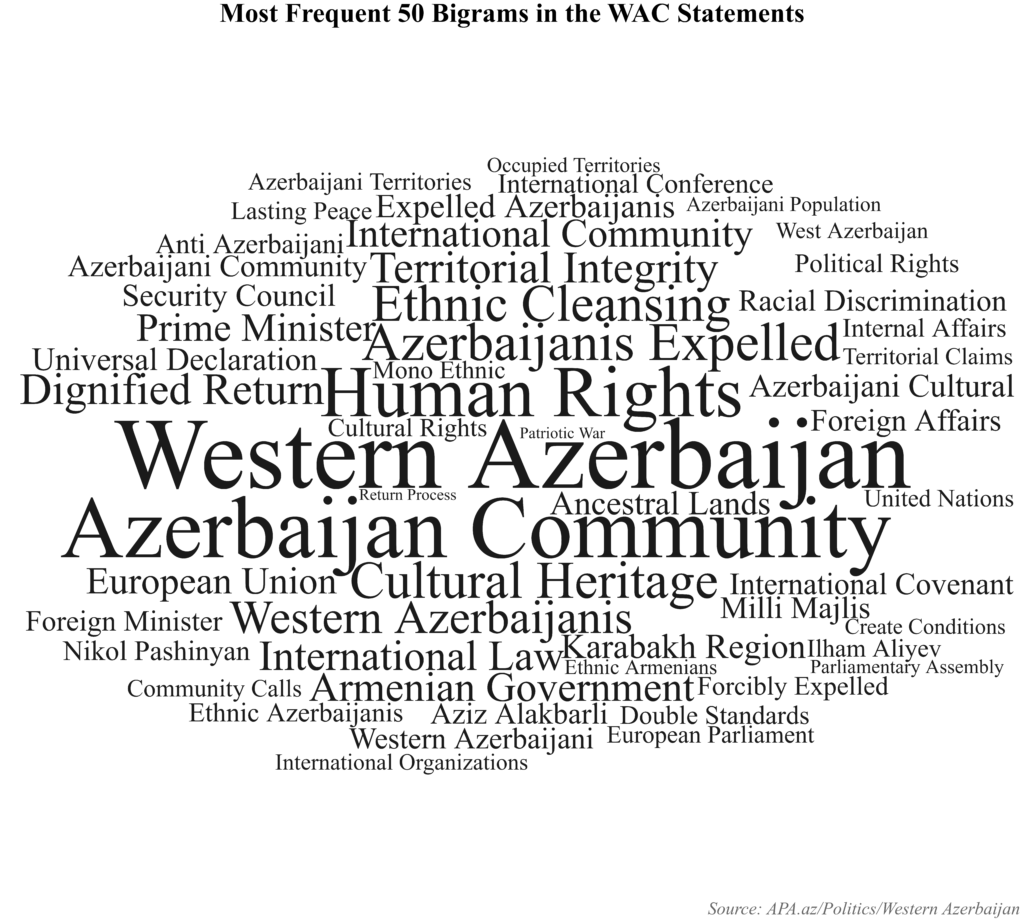
What do these expressions tell us about the organization’s messaging? Although it might seem a bit complex at first glance, distinguishing and grouping them into similar categories helps reveal the underlying themes behind the organization’s messaging. The first group of expressions tell stories of alleged discrimination and forced displacement WAC’s members and proponents claim they once experienced such as “Expelled Azerbaijanis”, “Ethnic Cleansing”, “Forcibly Expelled”, “Racial Discrimination”, “Anti Azerbaijani”, “Occupied Territories” etc. The second group, on the other hand, refers to the organization’s primary objectives such as “Dignified Return”, “Return Process”, “Ancestral Lands”, “West or Western Azerbaijan”, “Azerbaijani Territories”, etc. The organization also raises demands for “Political Rights”, “Cultural Rights” and “Cultural Heritage”. The third group of expressions seem to address the international community: “Security Council”, “United Nations”, “European Union”, “International Law”, “Universal Declaration” (perhaps referring to the “Universal Declaration of Human Rights”), “International Covenant”, etc. A closer look at the picture would also reveal the absence of conciliatory wording, for example, citing cooperation or diplomacy for conflict resolution.
Figure 2. visualizes the monthly frequency of Aliyev’s and WAC’s irredentist statements. The higher the volume of publications the more active the organization or the official propaganda was in a given period.
Figure 2
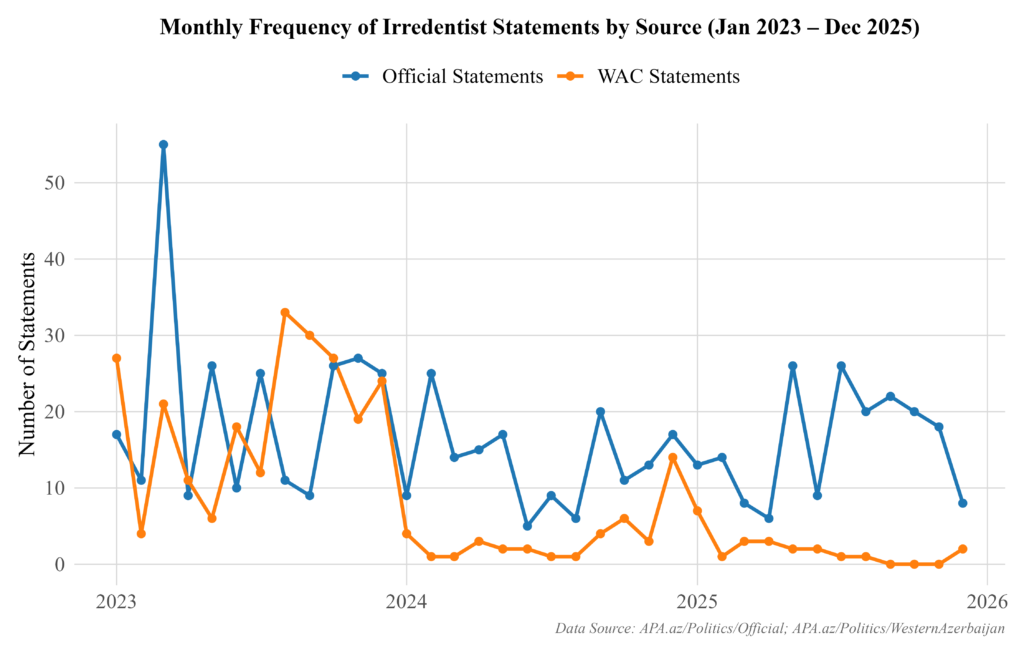
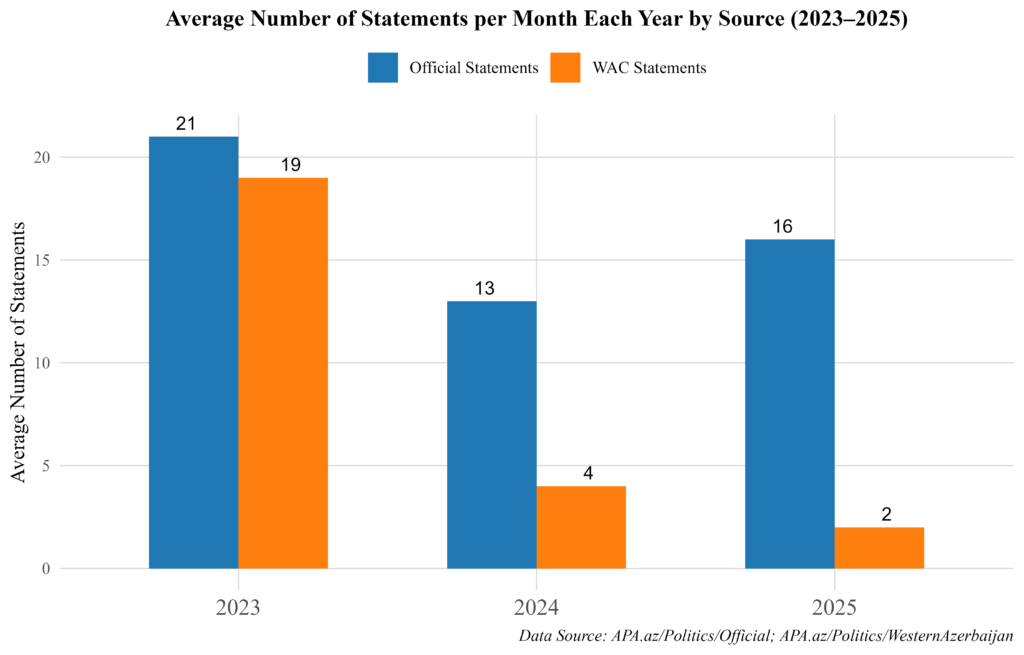
Obviously, the year 2023 was a relatively active period for both. The number of WAC’s monthly statements significantly declines since 2024, whereas the official ones, overall, remain steadily high.
Figure 3
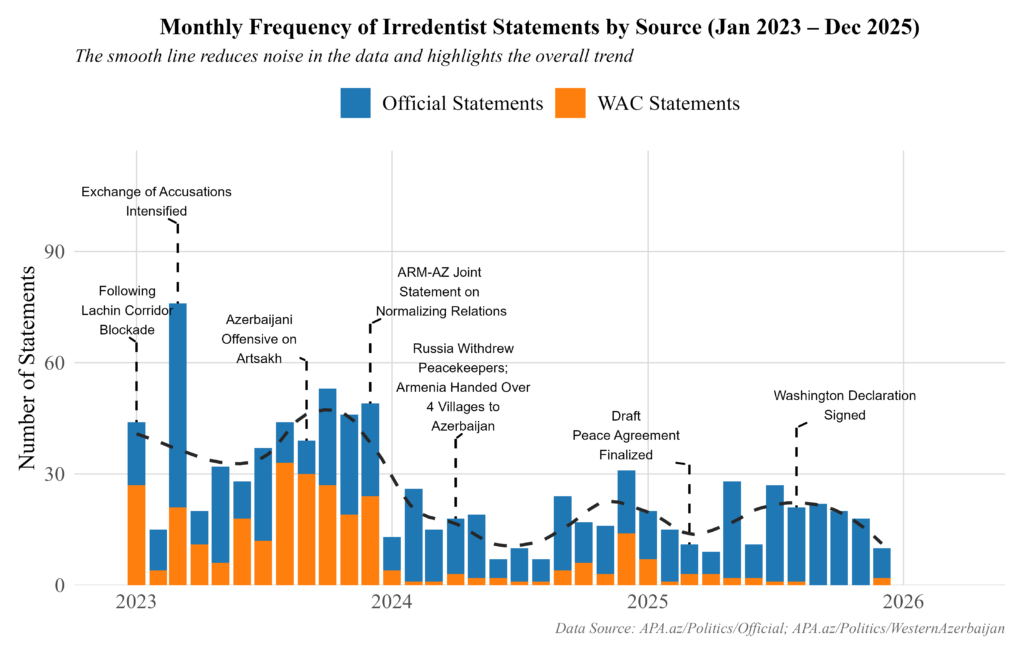
Notably, as Figure 3 indicates, periods of relatively higher issuance of irredentist statements by both actors coincide with major political-military developments between Armenia and Azerbaijan. For example, January 2023, one month following the blockade of Lachin corridor in December 2022 (European Parliament, 2023), was a relatively active period which even surged in March 2023, when the tensions and mutual accusations between Armenia and Azerbaijan intensified (MFA of the Republic of Armenia, 2023). As the graph shows, WAC was most active in the months prior, during and after the 2023 Azerbaijani offensive on Artsakh, which was even vividly visualized in Figure 2. The high intensity remained in December 2023, when Armenia and Azerbaijan released a joint statement on normalizing relations between the two countries (The Prime Minister of the Republic of Armenia, 2023). Overall, contrary to WAC activity, the government’s propaganda remained steadily high both in 2024 and 2025, especially following the signing of the trilateral declaration by the leaders of Armenia, Azerbaijan and the US on 8 August in Washington (US Department of State, 2025).
The dotted smooth line was added to the chart to reduce noise in the data (short-term fluctuations) and highlight the overall trend. As it indicates, most irredentist statements were made in 2023, which gradually decreases starting from 2024, but again becomes steadily high at the end of the year and throughout 2025 (on average, more than 15 irredentist statements per-month).
Counting the monthly averages and visualizing by year further clarifies this picture. As Figure 4. represents, the average number of WAC statements per month sharply declined from 19 in 2023 to 4 in 2024, and to 2 in 2025. Whereas the official statements experienced only a slight decrease in 2024 (from 21 in 2023 to 13 in 2024) but grew again in 2025 (16 statements per month).
Figure 4
As seen, the narratives around “Western Azerbaijan” promoted by the Azerbaijani government and the “Western Azerbaijan Community” are deeply anchored in irredentism towards Armenia, a policy of making territorial claims from the neighboring sovereign state that its supporters consider “historically” or “rightfully” theirs, with additional demands for “political” and “cultural” rights. Furthermore, the data show that spikes in irredentist sentiment largely coincided with key political and military developments between Armenia and Azerbaijan. In other words, the more tense or tumultuous the two countries’ relations get, the more vocal the Azerbaijani government’s and the WAC’s irredentist voices become.
Conclusion
The data reveals several clear and troubling trends in the re-emergence and rise to greater prominence of the “Western Azerbaijan Community” in the post-2020 period, along with the broader state rhetoric surrounding it.
As the data tells, the irredentist statements intensified sharply throughout 2023, coinciding with the blockade of the Lachin Corridor and the forced displacement of the entire Armenian population of Nagorno-Karabakh in September 2023. This synchronization underscores how the “Western Azerbaijan” narrative was used to justify, accompany, or normalize coercive actions on the ground.
At the beginning of 2024, a notable decline in WAC’s public activity became evident, while the official ones remained steadily high. The high frequency of the official irredentist statements, which continued in 2025, likely reflected the government’s perceived “triumph”, especially following the announcement of finalizing exchanges on peace treaty draft in March 2025 (MFA of the Republic of Azerbaijan, 2025) and the signing of the Washington declaration in August 2025, an event publicly framed as the successful completion of Azerbaijan’s strategic objectives (Azertag, 2025).
Throughout this period, WAC functioned as a state-orchestrated smokescreen, designed to create a facade of moral equivalence between Armenia and Azerbaijan. By portraying the conflict as a symmetrical one in which “both sides” possess historical grievances and alleged “rights to return,” the Azerbaijani government weaponized an NGO platform to win the diplomatic argument of both-sides-ism.
Yet, the evidence demonstrates that the rhetoric of “Western Azerbaijan” bears no relation to genuine human-rights discourse. Following Azerbaijan’s military victory in 2020 and the state policy of erasing Armenian cultural traces from Nagorno-Karabakh (European Parliament, 2022), this rhetoric has been repurposed into an expansionist policy aimed at Armenia itself. The chairperson of the “Western Azerbaijan Community,” commenting on the Washington documents, openly declared that the organization would continue its efforts toward a “return to ancestral lands” (APA, 2025), a direct reference to the sovereign territory of Armenia. Moreover, the presidential administration and academic institutions of Azerbaijan alongside the WAC jointly organized a festival-congress titled “Return to Western Azerbaijan” in Nakhijevan on 18-19 June 2026. As announced, the program includes presentations on “historical heritage of Western Azerbaijan and prospects for return” (Report.az, 2026), which further demonstrates how the irredentist discourse of official, academic and civil society institutions is closely aligned and complement each other, thus reinforcing its political salience.
The “Zangezur Corridor” concept, which was first officially articulated in the 2021 Shushi Declaration signed between Turkey and Azerbaijan on 16 June 2021 (President of the Republic of Azerbaijan, 2021) and has since been regularly invoked in national political discourse, represents yet another manifestation of this same expansionist logic, an attempt to redefine geography, sovereignty, and connectivity according to unilateral Azerbaijani ambitions.
Ultimately, the political euphoria following the signing of the Washington documents in August 2025 should not obscure the realities exposed by this rhetoric. As the data shows, paper agreements alone have limited capacity to restrain expansionist intent when a political mindset is driven by historic grievance, dominance, and triumphalism. Supported by a revitalized alliance with Turkey, Azerbaijan’s post-war strategy appears focused not on reconciliation, but on extending its sphere of control, militarily, politically, or economically, into Armenia itself.
Taken together, these findings confirm that WAC operates not as a genuine civil-society actor, but as a state-backed instrument of narrative warfare. It merges propaganda, diplomacy, and irredentism into a coherent political tool. Its activity illustrates how authoritarian governments instrumentalize NGO facades to legitimize aggression, manipulate historical narratives, and erode the boundaries between public diplomacy and state propaganda.
Beyond the Armenian context, this case demonstrates how modern authoritarian regimes employ propaganda ecosystems to fabricate moral symmetry, exploit international legal language, and reframe aggression as grievance. Recognizing and exposing such narrative manipulation is essential not only for understanding the current phase of the Armenian-Azerbaijani conflict, but also for strengthening global mechanisms against the normalization of revisionist, expansionist policies cloaked in the language of human rights.
Reference List