Data-Driven Insights into the “Western Azerbaijan” Discourse

Research

he previous part of the research series can be read at the following link: An Ally of the West or Hamas’s Political Patron: Turkey’s Double Game․
Is Turkey considered a reliable ally within NATO?
Today, many politicians and analysts are attempting to address this important question.
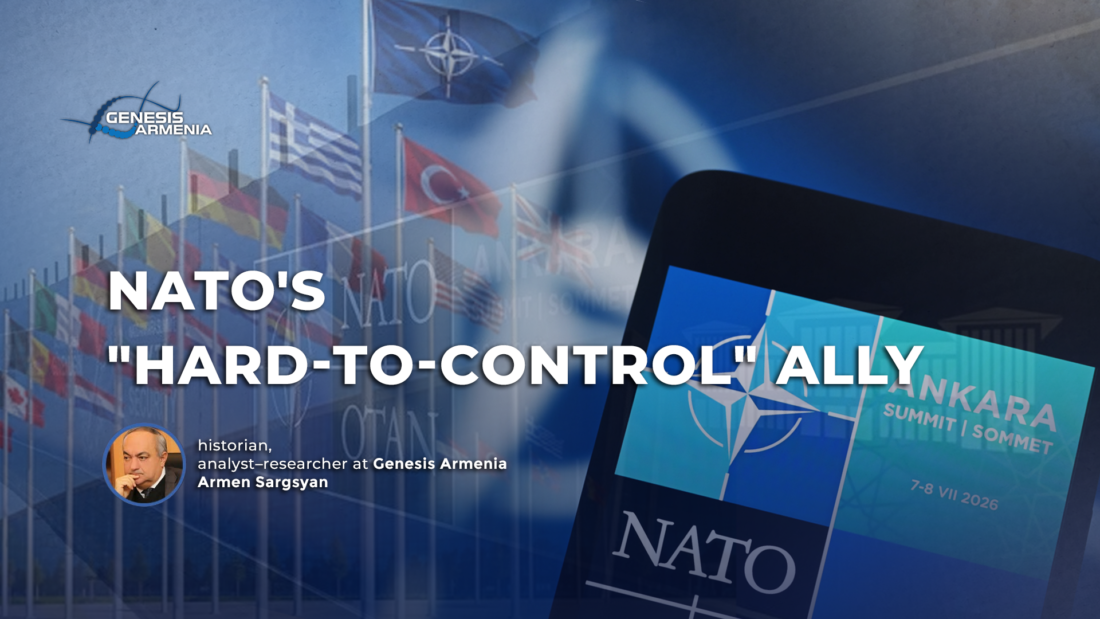
Despite a number of contradictions with NATO, President Erdoğan, speaking about the alliance’s prospects, has stated that the NATO summit scheduled for July 7–8, 2026 in Ankara could become one of the most significant events in the alliance’s history, and an opportunity for a systemic reset of strained US–NATO relations.
Turkey remains formally a trusted NATO member, yet in practice its positions have often been a source of criticism and concern among alliance members.
Officially, Turkey has been a NATO member since 1952. It participates in military cooperation programs, joint drills, and supports NATO’s defense systems. From this perspective, it is considered a reliable member, as it has not committed serious violations of its legal obligations.
However, in pursuit of its own interests, Turkey seeks to maintain a balance between NATO and Russia, who are at war on Ukrainian territory. And it must be said that, so far, Ankara has largely succeeded in sustaining this balancing policy.
Recently, tensions between Turkey and US ally Israel have visibly escalated, though for now I do not believe they will develop into a full confrontation. Israel is attempting to extend its influence into parts of the Middle East where Turkey holds significant sway, including the South Caucasus. Interestingly, Israel is seeking to do so through Azerbaijan. This process is still in its early stages, and its continuation will depend in part on the unresolved war in Iran and new geopolitical realignments in the region.
Although Turkey has long been concerned about Iran’s nuclear and ballistic missile programs and, of course, did not want Iran to become stronger, it is also worried that Iran’s potential fragmentation would create unprecedented instability in the region.
If Iran were to emerge from this war strengthened militarily and politically, Turkey’s role would undergo significant change—largely in the direction of redefinition.
For NATO, many regional problems are difficult to solve without Turkey. Taking advantage of its geographic position, Turkey seeks to position itself as a country that can engage with all regional actors, especially in times of crisis. At the same time, one of Turkey’s goals is to become the leader of the Sunni Muslim world. However, a strong Iran would clearly serve as a counterweight to Turkey։
Turkey is doing everything it can to stay out of the war against Iran, carefully maintaining its neutrality. Generations of Turkish politicians regard Ankara’s high-stakes balancing act during World War II as one of the golden chapters of Turkish diplomacy. At that time, Turkey’s leaders were deeply aware of the young republic’s geopolitical isolation and military vulnerability, and were determined not to repeat the mistakes of their Ottoman predecessors, who chose the wrong side in World War I.
Western criticism today is largely interpreted in terms of warning and deterrence, while Turkey’s position is a calculated strategy designed to ensure maximum flexibility.
Turkey may create certain challenges for NATO and the West, but it will never move into open confrontation. Ankara is an “indispensable” yet, to some extent, “unruly” partner for NATO.
In this situation, one axiom stands out: Armenia needs a fully developed foreign policy concept that includes a Middle Eastern strategy, actively expanding political, economic, and other ties with the region.